Saturday, March 5, 2022

Working As One Who Prays - From Praying in the Night by Tish Harrison Warren


I recently used this story to close a sermon and it is too good not to quote in full and make available.  Our preaching team will be reflecting on this book in a soon-future "Fear & Trembling Podcast" and I highly recommend it.  CLICK HERE for the amazon.com link.  


*     *     *     *     *     *     *

One perk of serving as a priest in a parish near teaching hospitals and universities is that I regularly get a front row seat to watch some of the world's smartest people embrace prayer and redemptive work together. 

One friend and parishioner, Noel, has trained and studied for decades to be among a few dozen doctors in the United States who can do the kind of pediatric surgery he does. Sometimes his surgeries take over 10 hours. They are complex, intense, and exhausting. And on those days, you can find Noel standing in a hospital break room, praying. 

Clipped to the door inside his surgical locker is a liturgy he prays before and during surgery. At the encouragement of his spiritual director, Noel wrote it himself, drawing from the Book of Common Prayer and Scripture he whispers:

“Grant me, oh Lord, for your sake, through the work of your Holy Spirit, 

love for my patient, 

joy in participating in this work, 

peace as I follow your lead, 

patience in the trying times of this case, 

kindness... to all in the room, 

goodness in this difficult task, 

faithfulness to have integrity in the details even when no one else but you sees... 

and self-control that my own sins of 

anger, 

anxiety, 

and vainglory 

would not mar my judgment.” 

He prays for his patient by name. And he scrubs back in and continues surgery.

His patients rave about him. One father says simply, “He saved my daughter's life.”  But Noel tells me his job is simply a chance to be “a minister of common grace.” So as the sun sets at the end of a long day, Noel completes his work. A child has been helped and healed. And a man takes off his surgical mask and exhales a prayer of thanks that he could participate in God's restoration, that his work can be part of God's own work. 

My friend works as one who prays. And prays as one who works. 

From: Prayer in the Night, by Tish Harrison Warren – p. 74

Tuesday, January 25, 2022

A Good Example of “The Big Shift”

I recently posted an outline and explanation of a helpful metaphor from Harderwyk’s Executive Pastor Dr Darwin Glassford that I called "The Big Shift."  CLICK HERE  It has helped me recognize that I am living and leading through change that happens around me on three “levels.”  Like the ocean, there are 1) Surface Storms, 2) Undersea Currents or Riptides and 3) Tectonic Shifts that cause change and turmoil, but in different ways.

Shortly after that post, I came across an article that exemplified the “Big Shift” metaphor for me.  The post is “The Difficulties of Teaching About Divorce in an Anecdotal World by Alexander Riley on ThePublicDiscourse.com.  It is well worth reading on its own.  CLICK HERE to do exactly that.  

In brief, Riley makes the case that social research is abundantly clear that the children of divorce experience an increase in negative life outcomes, even when controlling for other variables like income, education, location and others.  He finds it difficult to engage his students with this conclusion though not because the research is lacking, but because the students have been taught to “embrace the view that relativist, subjectivist and ultimately personal experiential knowledge is the only kind available to us.”  His students are thinking that “my story” or anecdote beats your scientific study of a larger population.  Push that thought further and we are talking about sacrificing scientific conclusions on the altar of personal experience.

Here is where the “Big Shift” ocean metaphor comes in:

  • The impact of divorce on children is an issue on the level of a Surface Storm.
  • The triumph of anecdote over science is an Undersea Current or riptide.
  • My guess is that both of these are energized by a “Tectonic Shift” resulting from the “Rise and Triumph of the Modern Self” to borrow the title of Carl Trueman’s excellent book.

For me to have a conversation with someone about the impact on their children of the divorce they are considering, I will need to recognize the “my-anecdote-trumps-your-science” riptide that may be below the surface.  And this, not so much to “win the argument,” as to communicate a reality in a way this person will hear.


Thursday, January 20, 2022

Found In, Formed By, and Following . . . What Exactly?

Here at Harderwyk, we have recently invested a lot of time and effort  into articulating, understanding and living a new statement of our ministry vision.  We even did a sermon series about it from Sept 19 to Oct 24 in 2021.  We talked a lot about being Found In .  .  ., Formed By  .  .  . and Following  .  .  .  Christ.  That statement makes sense to me.  After all we are a church!

But recently, I realized how different it was to be Found In, Formed By and Following Christ, compared to what I grew up with in Bible-Belt-Culture.  There I was Found In, Formed By and Following .  .  .  Bible-Belt-Culture. 

Granted, Bible-Belt-Culture was pretty friendly to church life and participation.  Fifty years ago that culture would even be considered a good setting to begin and grow in a personal faith in Christ.  But Bible-Belt-Culture and Christ are not always identical.

I’m thankful that within that Bible-Belt-Culture, Jesus eventually broke in and enabled me to surrender to Him as Lord and Savior.  I responded to His Grace with a personal faith and began the life-long journey of Gospel-centered discipleship. 

That meant, I eventually had to start learning the WHY of some of the behaviors and values that were imparted to my life from that Bible-Belt-Culture.  Frankly, there were behaviors and habits I needed to change, or even drop.  Over time, I even saw that I had picked up some things from Bible-Belt-Culture, that I actually needed to repent of. Being Found In, Formed By and Following Christ in a real way, turns out to be different than Being Found In, Formed By and Following Bible-Belt-Culture.  Ouch!!

This is a dilemma and an opportunity at the same time.

For people accustomed to “Bible-Belt-Culture” type cultures – let’s call them “Christendom” from this point on and include Western Michigan – the natural impulse and experience is to be pretty comfortable being “Found In, Formed By and Following” the surrounding culture.  After all, that surrounding culture in a Christendom setting is “Christian.”  The culture is meant to shape us into a mature Christian believer.

I am pretty sure that has never been true, but it can be easy to be fooled into thinking it when we are living in a Christendom setting.  “Go with the flow and be a Child of God!”  Not really.

Certainly the Holy Spirit can find His way into people’s lives within Christendom.  That is certainly my story.  Ponder that: God’s grace can transform people, even in Christendom.

But what happens when Christendom disappears – when the surrounding culture is no longer “Christian” in any meaningful way with regard to worldview, values, habits or behaviors??

There is a dilemma!  Being Found In, Formed By and Following a Culture that is no longer reflective of Christ will obviously not lead you to a life reflective of Christ.  That culture – whether it is “non,” or “anti” or “post” with regard to historic Christian faith – will not form you in way that is meaningfully Christian.

When Christendom is gone, you can’t look to the surrounding culture to form the live of you and your children.

But what an opportunity!

We can go directly to the source of our faith so that we are Found In, Formed By and Following Christ Himself.  There may no longer be a surrounding culture to mediate or encourage a personal faith, but the Source of Our Faith is still alive and well.

I’m no longer looking to our culture to shape people as Christ-Followers.  Instead, I’m excited about helping people be Found In, Formed By and Following Christ, so that we can offer the Gospel, and perhaps even shape, the people and culture that we live in.  THAT is the opportunity!

Wednesday, January 19, 2022

Everybody’s Feeling It: "The Big Shift" On Three Levels

I’m indebted to Harderwyk’s Executive Pastor Dr. Darwin Glassford for a metaphor that has stuck with me since a recent ministry staff retreat.  It’s helped me sort through “The Big Shift” going on in our world that I’ve been sensing at every turn.  The metaphor uses the ocean to organize different and changing influences on life and ministry at this moment.  Let’s start.

Picture the ocean.  That is like life.  It is the location for work, play, relationships and ministry.

Now picture three distinct types of disruption that affect life on the ocean:

  • Surface Storms
  • Sub-Surface Currents that operate “below-the-surface” but affect life on the surface
  • Tectonic Shifts that occur at the very “foundation” of the ocean with long-term effects on everything.

Now, let’s develop these with examples.

Surface Storms – There are all sorts of storms – rain, wind, ice.  Hurricanes, typhoons.  They are real.  They can be big.  And they can make life as a sailor or fisherman difficult, even dangerous.

But these things pass and life gets back to “normal” – that is, to the status quo life on the surface “much-as-it-was.”

We are all always navigating a number of Surface Storms in our life.  Sometimes as a culture.  Sometimes as a nation or community.  Other times as a family or individual.

For concrete examples of Surface Storms, think:  COVID, elections, death of a spouse or family member, change of job, car breaking down, getting cut from the team.  Things that are real and need to be dealt with in life.  Sometimes dealing with them can be hard or take longer than for other events.  The key here is that once the “Storm” is passed your situation is much the same as it was before the storm.  Your resources, your relationships, the institutions – all the things that you would call “part-of-life” – are mostly still there.  The characters may have changed or an item in the setting may be missing, but the stage remains.


Sub-Surface Currents – Think about riptides or the Gulf Stream in the Atlantic Ocean.

You can stand on the shore and perhaps not notice them.  The sun is out.  The wind is refreshing.  Everything looks “the same.”

But go out on the water and things are different.  The riptide carries you out and away, even when you swim towards the shore.  The Gulf Stream brings warm water up the Eastern coast in a way that affects the local weather.

No matter what it looks like on the surface, these Sub-Surface Currents have real affect from below on the life of a sailor or fisherman.  If you are not actively resisting the current, you are being carried along to wherever it is going.

Looking around our life, it is easy to see that American culture is becoming increasingly “post-Christian.”  Moral questions are increasingly matters of personal preference.  “You do you” is how expressive individualism works out as a world view.  And it is a riptide that will carry you along where it is going.  A storm may end, but the Gulf Stream keeps dragging things northward with it.

Life is sunny for a season, but deep inside, the focus of your life is being carried away in ways that you may at first miss.  All you have to do is float along, but your location gets changed.


Tectonic Shifts - These deep, undersea events cause tsunamis halfway around the world.  Sailors are capsized.  Islands appear where there was only ocean before.  Just this week there was a volcano near the Pacific Island of Tonga.  Now there is a new island and waves were high near San Francisco.

Right now, our culture is being altered by deep and often unseen shifts far below the surface of our everyday lives.  A few people note the earthquake, but nobody expects the tsunami to hit shore thousands of miles away.

Carl Trueman’s recent book The Rise and Triumph of the Modern Self - Amazon Link - points to a Tectonic Shift in our time.  I recommend Being the Bad Guys by Stephen McAlpine - Amazon Link - as a helpful place to start when learning about this Tectonic Shift now affecting our world.  CLICK HERE for my blog post on that book or CLICK HERE for a recent Fear & Trembling Podcast that Harderwyk’s pastors did.  These are good resources to start with.

They helped me see more clearly that the growing acceptance of life lived with the “self” as the only measure of reality and rejecting any transcendent point of reference for understanding life is like a Tectonic Shift in the history of humanity. People have been selfish before, nothing new there, but never have they determined all of reality from internal, personal experience alone.  That change dramatically affects how selfishness works out.

Greek Mythology, Christianity and Islam for example, all point to different deities.  But those different deities, and the values they reveal, are all from "outside the system" of purely physical reality and human experience.  That is what I mean by "transcendent."  Once, people viewed life with a sense of something beyond physical life.  Now, we do not.  That is a Tectonic Shift.

It seems to me that we are now navigating major changes on the Surface, at the level of unseen Currents and from deep, Tectonic Shifts.  Frankly, I am of the conviction that there are significant changes on all three levels happening and interacting at the same time.  No wonder we’re all feeling overwhelmed of late.

My friend Darwin’s metaphor has given me a new way of thinking – and praying for – all sorts of situations that I face in ministry.  For example .  .  .

  • It is a Surface Storm when a friend observes that their grandchildren are not being “raised in the church.”  That may well be a reflection of the Sub-Surface Current of identifying as “spiritual, but not religious.”  Even that current, may have been set in motion by the Tectonic Shift from thinking of God and faith as being revealed to us, to the current prevailing sense that spiritual truth is determined by each individual.
  • Let me try another possible example: There may be a Storm this summer in our culture when Christian denominations address the question of human sexuality and same-sex marriage.  But below the surface is the growing Current of absolute sexual freedom of expression.  That current has been strengthened by the Tectonic Shift of sexual identity and desire being self-determined.

I am realizing that I spend much time with people navigating the “Storms of life” in the many forms they take.  I will keep doing that. Increasingly though, I’m seeing the need to help people recognize, identify, respond to and prepare for these Sub-Surface Currents and the deep-sea Tectonic Shifts. 

So now, to play out the metaphor to our current cultural moment, I would say:

While we have been busy trying to survive Hurricane COVID (Surface Storm) there has been an undersea earthquake (the rise of Philip Rieff’s “third culture) that has split the continents of Europe and North America (Tectonic Shift) and caused the Gulf Stream to now flow east to west (Undersea Currents of “post-Christian culture).

So am I anxious to be done with COVID?  Of course!  Do I think that will get us “back to normal”?  Not really.

Whew! Right now is a good time to take a deep breath and be reminded that we don’t need to bear all by ourselves the burden of sorting through these shifts and their impact on everyday life.  Jesus identifies Himself as the Good Shepherd who will care for and lead His flock as we listen to His voice.  (John 10:1-10)  He will speak through His written Word – the Bible, through His community – the Church and through the Spirit as we pray.  Our calling is to be faithful.  Listen.  Discern.  Obey.  Repent.  Repeat as needed.

*     *     *     *     *     *

As with everything I post, I am happy to listen to your questions and responses.  I learn more by engaging with others – especially those who see things differently.  You’re invited to contact me through the office of Harderwyk Ministries.  We can talk, or perhaps sit down for coffee, but let’s go the next step together.  These are challenging times to navigate.

Discerning The Times: Grasping The Perspective of Philip Rieff

Our Preaching Team here at Harderwyk recently produced a podcast on the outstanding book “Being the Bad Guys by Stephen McAlpine.  The subtitle says it all: How to Live for Jesus in a World That Says You Shouldn’t.  McAlpine is Australian, so his ministry context is a bit different than ours, but only that it may be “further along” down the path of post-Christian culture.

 It’s a great book: very readable and full of insights.  I’ll leave the podcast to your judgement.

 I do want to make available a passage from McAlpine’s book because of the helpful way it summarizes a particular perspective that is gaining support.  You can read about Philip Rieff and his work in authors like Charles Taylor and Carl Trueman who dig deep into “third culture deathworks.”  But no one has presented a summary of his thought that is clearer and more understandable – not to mention applicable to the life of a disciple of Jesus in these times – than the following:

*     *     *     *     *     *

Come and Buy

Two decades or so ago, there was excitement among evangelists and those involved in the missional church movement that the world was returning to a pre-Christian period in which claims of the gospel would be seen afresh - removed from all the traditional cultural associations. I attended meetings in cafe and pubs which discussed the new world we were facing and the opportunities it presented. Our strategy for church planting and evangelism was based on a conviction that postmodernity had leveled the playing field. The Christian faith was now one of many competing spiritual claims in the public square.

Philip Rieff, an American sociologist, had described much of the pre-Christian world as “first culture”: a world of many competing gods that were tribal in their allegiances and demands. First culture was not evangelistic. Each God and his or her worshippers kept to their own patch.

“Second culture”, Rieff argues changed things. Second culture was monotheistic and evangelistic. Christianity broke down tribal barriers with its commitment to equality across sexes, races and social divisions. It swept the first cultural away.

Now, with the eclipse of second-culture values in the West, we thought we were returning to the first culture – effectively, a pantheon of gods. So, the strategy was clear. Christianity would set up a stall alongside everyone else in a free market. And we were confident that, given the chance to offer our wares alongside everyone else’s, our products would be more compelling. All we had to do was to strip away the detritus of Christendom that had built up over the centuries - the overt institutionalism, the push for temporal power, the alignment with economic structures that fueled greed, and the less-than-attractive liturgical forms. The pure and simple claims of Christ could be presented and examined without prejudice by a culture just waiting for some good news. Churches sprang up in households and pubs across the West, ready for an influx of new enquirers.

But that tactic has not worked. Too often, those people who began this new movement ended up more like the people in the pub than the people in the pub ended up like Jesus. Often this was led from the top, as early mission leaders such as Rob Bell moved from a stated theological humility to walking only be classed as heretical viewpoints.  .  .  .

.  .  .  The reason this happened is becoming clearer. What we are experiencing now is not a return to pre-Christianity but a move forward to something new: a post-Christian reality. It is what Philip Rieff labeled “third culture”. First and second cultures have something that third culture does not possess: a spiritual or transcendent order that gave shape to the social order. People related to God or the gods through social and cultural structures in which temples and other holy locations, families and households, liturgical calendars and seasons all pointed to realities beyond themselves. The patterns established on earth were exactly that patterns of something transcendent.

Third culture rejects this spiritual reality. The third-culture world is hermetically sealed off from anything transcendent and recognizes only horizontal identity constructions, not vertical ones. Here is where meaning is determined, and here is where authority lies. It is ours to construct and deconstruct.

 Simply put, when we decided we were headed back to a pre-Christian world view of the world which would give us the kind of hearing we had back in the early centuries, we misread the data. Unlike the first culture, this third culture is highly evangelistic and actively hostile to second culture values. It has features and inbuilt bugs that render it resistant to many of the tactics employed in pre-Christian days that we were confident would work again.


We'll Take It From Here

Secular cultural commentators have read the data better than Christians have. In his book The Madness of Crowds, British author and commentator Douglas Murray, who is gay and an atheist, says that we have been living through “a period of more than a quarter of a century in which all of our grand narratives have collapsed”. But, of course, nature abhors a vacuum. Murray goes on to say this: “Western democracies today could not simply remain the first people in recorded history to have absolutely no explanation for what we are doing here, and no story to give life purpose”.

 Even an atheist such as Murray recognizes that we are facing a new religion - one built on commitment to individual autonomy and celebration of personal authenticity at any cost. It is a new religion that finds ultimate meaning in the self, to counter the gospel that finds ultimate meaning in God and his King, Jesus Christ.

 From Being the Bad Guys by Stephen McAlpine, pp. 24-28

 *     *     *     *     *     *

Here is a compressed summary of Rieff’s perspective from his obituary in The Guardian:

Rieff's five-stage view of history is now reduced to three: a first, pagan world embracing Plato and aboriginal life; a second, religious world from Judaisim to Islam; the third world is the current mess, which has lost that order he calls "vertical in authority". - CLICK HERE for the entire obituary.  


To learn more about Philip Rieff and his thought, I would suggest:

CLICK HERE for the Wikipedia Article on him.  It is brief, but interesting 

CLICK HERE for his New York Times obituary

CLICK HERE for A Theological Sickness unto Death: Philip Rieff’s Prophetic Analysis of our Secular Age.  Published in the theological journal Themelios and posted by TheGospelCoalition.org


Resources

Philip Rieff, My Life Among the Deathworks (University of Virginia Press, 2006)

Charles Taylor, A Secular Age (Belknap Press, 2007)

Carl Trueman, The Rise and Triumph of the Modern Self: Cultural Amnesia, Expressive Individualism, and the Road to Sexual Revolution (Crossway , 2002) – CLICK HERE for the Amazon link

Thursday, December 2, 2021

If This Guy Is Looking For A Bass Player, I’m Available!

One of the great joys of preaching at Harderwyk for me is the chance to collaborate with my friends Pastor Aaron VanDerVeen and Pastor JB Wernlund. We pray and study together each week sharing ideas and resources. It was JB that introduced us to Daryl Davis and his story as we prepared for our sermons on Sunday, November 21. CLICK HERE to see that service.  The sermon begins at about 28:00 and the illustration come in around 51:00.


But there is soooooooo much more to Daryl’s story than I was able to share on that Sunday, so I’d like to collect all that I learned for you to enjoy as well.

 An African American Confronts the Klan in “Accidental Courtesy” - This 2016 article in Christianity Today magazine gives more focus on his Christian faith.  CLICK HERE- or go to www.ChristianityToday.com and enter "Daryl Davis" in the search box.

Accidental Courtesy: Daryl Davis, Race & America – Is the documentary film mentioned in the article above. In my search, I have found that it is no longer available on Netflix, but can be streamed – for a price – on Amazon.com.  CLICK HERE to purchase access. Because of my schedule, I have not yet seen it, so check back for my comments in a week or so. 

Daryl Davis - Who Lights The Way for Jesus? – This is a 2-minute YouTube by the Veritas Forum where Daryl Davis recounts the story a conversation he had with a “Klans-friend” where he points out that the Klan worships a different Jesus than Christians do.  CLICK HERE

Daryl Davis – Amazing Boogie Performance – Not sure what “Boogie-Woogie” is all about? In this 3-minuted YouTube - CLICK HERE, Daryl explains with his fingers on the keyboard. If this guy is looking for a bass player, I’m available!

 Daryl Davis – Sermon Illustration - Finally, here is my text from the sermon telling Daryl’s story edited from a March 18, 2020 article in the British daily The Guardian.  CLICK HERE for the full article.

The story starts in 1983, at a roadside juke joint called the Silver Dollar Lounge in Frederick, Maryland. Daryl's band was the headliner that night and being the only black man present did not perturb him at all.

After he and his band finished their set, Davis was approached by a patron who was around 15 years his senior. Not an unusual occurrence for a working musician. However, while praising Davis on his performance, the patron candidly noted that he had never seen a black man who could play like Jerry Lee Lewis.

More curious than offended, Davis used this encounter as an opportunity for friendly discourse rather than outrage. “I explained to this older white guy that Jerry Lee Lewis was influenced by the same black boogie-woogie and blues piano players as I was,” Davis says with a chuckle. “He didn’t believe me. Then I told him that Jerry Lee is a good friend of mine and well, he didn’t believe that either, but he was fascinated.”

“So he asks me to join him for a drink,” Davis continues. “Now, I don’t drink so I had a glass of cranberry juice and then he took his glass and cheered me. Then he said, ‘You know, this is the first time I ever sat down and had a drink with a black person.’ I was instantly curious and thought, ‘What’s going on here?’ So I asked him why. He didn’t answer at first but eventually admitted that he was a member of the Ku Klux Klan.”

Daryl has continued to engage and befriend members of the KKK. Growing out of these conversations, many of them centered on Christian faith, over 200 have left the Klan, and given Daryl their robes!!

Friends that is the adventure of the Grace-Gifted Body of Christ

          Living in the adventure of our moment as a Missional Minority

Joining the Journey with others

          To be Found In, Formed By and Following Jesus

Grow Your Heart In The Gospel This New Year

 The New Year Is Coming

I am not typically inclined toward “daily devotionals.”  You know the books that have a one-page thought for each day of the year? For my own life – and for those I am discipling – I usually focus on developing the spiritual discipline of daily Bible reading, especially with the Lectio Divina method.  Think of it as getting to the source itself, rather than getting second-hand thoughts from someone else.

That said though, I have had a great time over the past few years meeting twice per month with a group of men over breakfast where we take a gospel-centered “daily devotional” and use that as our starting point for spiritual conversation. Every other week we order breakfast and then ask each other, “So what did you underline over the past two weeks?”  This format seems to have given us all the right balance of focus, content and freedom, so that the participation, reflection and growth for each of us has been wonderful.

The key to this all working seems to be having a really solid and “Gospel-Centered” devotional book as the starting point.

 It is not about “inspiration for my day:” an engaging illustration to ponder, or a memorable moral or a nugget of Bible knowledge. Instead, the devotionals that we have found and used help us navigate the pathways of our heart and be fed on the Good News of our new life “in Christ” as adopted children of the great King. The conversation has been rich because of the richness of the Gospel of God’s Grace.

Here are three of the devotionals that I can say are “tried-and-true.”  Why don’t you consider picking one up for yourself, or giving one as a Christmas present or better yet, get several and commit with some friends to a regular time and place to sit down together and as, “So what did you underline since we last met?”


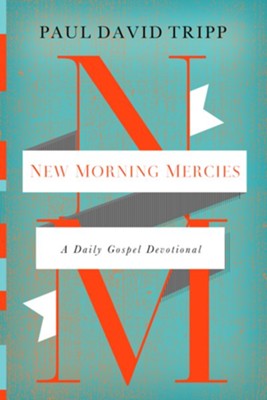
New Morning Mercies: A Daily Gospel Devotiona
l  by Paul David Tripp - 
Paul David Tripp is one of the best writers I know for navigating the depths of my heart and motivations in light of the Gospel.  His pastoral background shines through in these daily readings. CLICK HERE for Amazon.com link


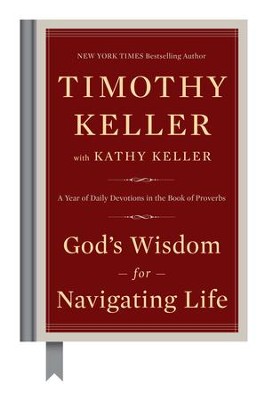
God’s Wisdom for Navigating Life: A Year of Daily De
votions in the Book of Proverbs by Tim & Kathy Keller – I call Tim Keller my “Gospel Yoda” and the people of Celebration know well the appreciation I have for him. These reflections on the wisdom of God in Proverbs are written with his wife and marvelous for facing the issues of daily life.  CLICK HERE for Amazon.com link 


Mockingbird Devotional: Good News for Today (and Every Day)
by Ethan Richardson and  Sean Norris - 
This one was a surprise for our group. I love the website MBird.com. The movie, music and pop culture illustrations were more natural to the Millennial demographic, but the Gospel was so richly permeating everything written, that each time we met we had great spiritual conversations. Plus, I learned more about the movies my kids are talking about!  CLICK HERE for Amazon.com link